
Social Media Comparison and Self-Worth: Why Other People’s Lives Can Make You Feel Behind
Social media makes it easy to see what other people are doing. You can watch someone travel to a beautiful place, celebrate a new job, move into a new home, or share happy moments with friends. At first, these posts may feel inspiring. But after a while, you might start asking yourself, “Why is my life not like that?” or “Am I falling behind everyone else?”
If these thoughts leave you feeling worried, unhappy, or less confident, speaking with a therapist for anxiety and depression NYC may help you understand your feelings and develop a healthier relationship with yourself.
Social media is not always bad. It helps us stay connected, learn new things, and share special moments. The problem begins when we use other people’s online lives to measure our own success, appearance, relationships, or happiness.
Remember, you are seeing only a small part of someone else’s life. You do not know everything they are dealing with behind the scenes. Your life does not need to look like someone else’s to have value.
In this article, we will explore why social media comparison happens, how it can affect your self-worth, and what you can do to feel more comfortable with your own journey.
Why Do We Compare Our Lives to Others on Social Media?
Comparing yourself to others is a common human experience. People naturally notice how they are doing compared with those around them. Social media makes this habit easier because other people’s lives are always just a few taps away.
You might open Instagram to relax for five minutes and end up spending an hour looking at other people’s achievements. You see a former classmate getting promoted, a friend announcing an engagement, or someone your age buying a house. Without realizing it, you may begin to compare their progress with your own.
The need for approval
Many people want to feel accepted and appreciated. Social media offers quick signs of approval through likes, comments, shares, and followers. When a post receives attention, it can feel exciting. When a post gets little attention, you might wonder whether people like you or care about what you share.
Over time, it can become easy to connect your value with how others respond online. You may start posting mainly to receive approval instead of sharing things that genuinely matter to you.
However, your worth cannot be measured by the number of likes on a photo. Online attention may feel good, but it does not determine whether you are a good friend, a caring partner, a talented person, or someone who deserves happiness.
The pressure to keep up
Social media can also create the feeling that everyone is moving forward faster than you are. People share graduations, weddings, holidays, new jobs, fitness goals, and personal milestones.
When you see these updates every day, it may seem as if everyone has a clear plan for life except you.
But people follow different paths. Some build their careers early, while others take more time to discover what they enjoy. Some find a partner quickly, while others prefer to focus on themselves. There is no single timeline that everyone must follow.
You are allowed to grow at your own pace.
The Difference Between Online Images and Real Life
One of the most important things to remember about social media is that a post rarely tells the whole story.
People usually share moments they want others to see. They may post a picture from a wonderful holiday but leave out the stress of planning the trip. They may celebrate a career achievement without discussing the years of hard work or uncertainty that came before it.
Even honest posts show only a small part of a person’s life.
You are seeing the highlights, not the full picture
Imagine that you are having a difficult week. You feel tired, your work is stressful, and you are unsure about your future. During a break, you open social media and see several people sharing exciting news.
One person is travelling abroad. Another has started a successful business. Someone else is celebrating a happy relationship.
It may seem that their lives are perfect while yours is full of problems.
But you are comparing your complete experience, including your doubts and difficult moments, with the selected moments they have chosen to share.
You do not see every disagreement, financial worry, lonely evening, or personal setback. Their struggles may simply be private.
This does not mean that everyone online is pretending to be happy. Many people genuinely enjoy their lives and want to share that happiness. The point is that a few posts cannot tell you everything about another person’s experience.
Filters and carefully chosen moments
Photos can also be edited, filtered, or taken from carefully chosen angles. People may spend time selecting the best picture, writing a caption, and deciding what to share.
When you compare your natural appearance with edited images, you may develop unrealistic expectations about how you should look.
Try to remind yourself that online images are not a fair standard for judging your body, appearance, or life.
A healthy relationship with social media begins with understanding what you are looking at. You can enjoy other people’s posts without treating them as proof that your own life is not good enough.
How Social Media Comparison Can Affect Self-Worth
Self-worth is the sense that you have value as a person. It does not depend entirely on your income, appearance, relationship status, career, or achievements.
When you compare yourself with others too often, however, it can become harder to remember this.
Feeling that you are not good enough
You might begin to think that you are not successful enough, attractive enough, fit enough, or interesting enough. These thoughts can appear even when you are doing well in many areas of life.
For example, you may enjoy your job until you see someone your age receiving a major promotion. Suddenly, your own progress feels less important.
You may be proud of your home until you see pictures of a larger one. You may feel comfortable with your appearance until you spend time looking at edited photos.
The problem is not necessarily that your life has become worse. Instead, the standard you are using to judge it may have changed.
Measuring your value through achievements
Social media often gives attention to visible success. People share awards, expensive purchases, impressive holidays, and major milestones.
These things can be enjoyable and meaningful. But they do not tell the whole story of a person’s character or happiness.
Being kind, keeping a promise, learning from a mistake, supporting a friend, or getting through a difficult day may never become a popular post. Yet these experiences matter.
Try to notice the things that make your life meaningful beyond what other people can see.
Losing touch with what you really want
Constant comparison can also make you question your own goals.
Perhaps you were happy with your career until you saw a friend starting a business. Now you feel pressure to become an entrepreneur, even though you have never wanted that lifestyle.
Or perhaps you enjoyed being single until social media made you feel that everyone should be in a relationship by a certain age.
It is worth asking yourself whether a goal reflects your personal values or a fear of being left behind.
You do not need to want everything that other people want. Your choices can be different and still be right for you.
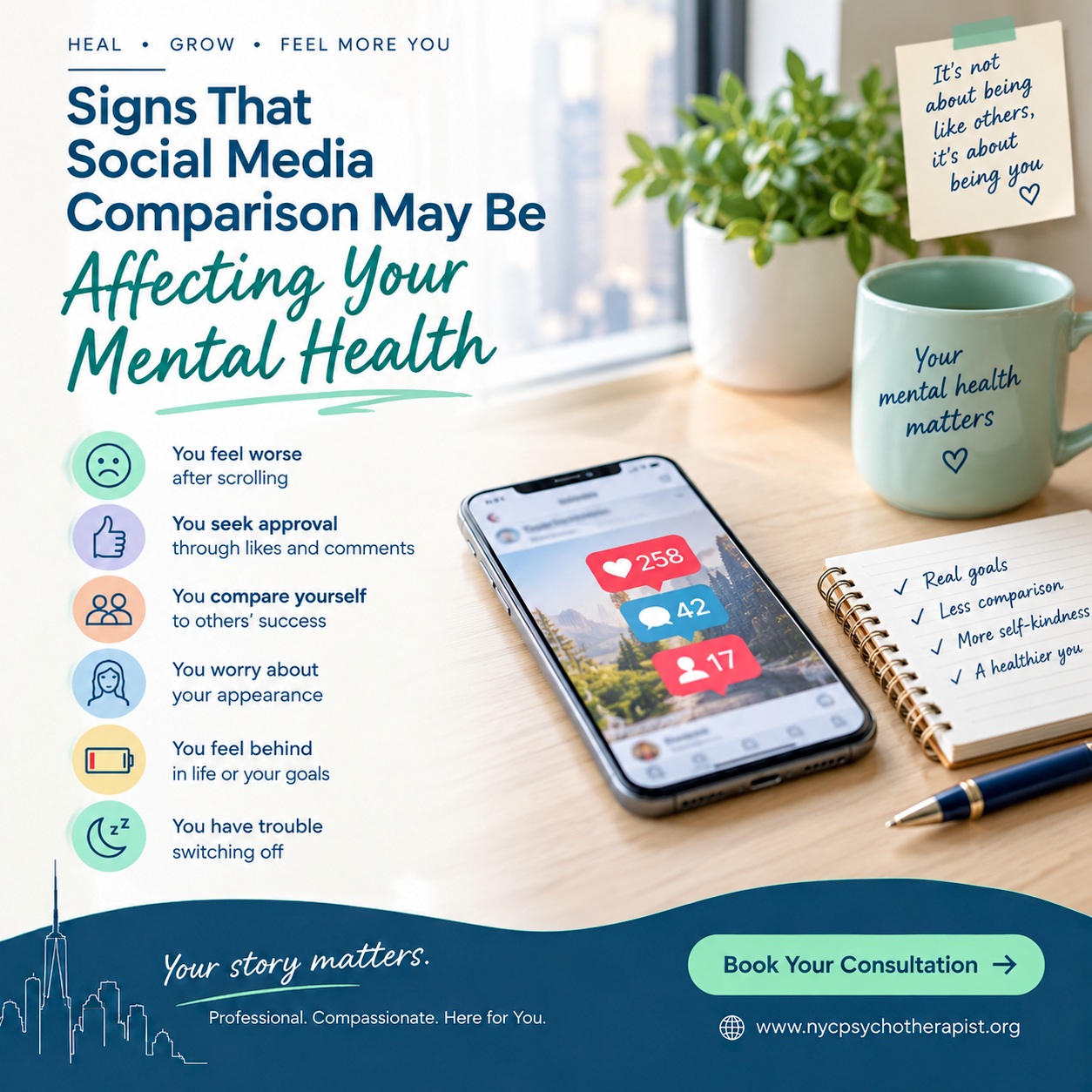
Signs That Social Media Comparison May Be Affecting Your Mental Health
It is normal to feel a little jealous or insecure sometimes. Having these feelings does not mean something is wrong with you.
However, it may be helpful to pay attention when social media regularly leaves you feeling worse about yourself.
Here are some signs to notice.
- You feel unhappy after scrolling. You open an app to relax but leave feeling disappointed, lonely, or frustrated.
- You keep checking for approval. You repeatedly check likes, comments, or views to see whether people have noticed you.
- You feel jealous of other people’s success. Their good news makes you question your own achievements instead of feeling happy for them.
- You worry about your appearance. You compare your face, body, clothes, or lifestyle with carefully selected images.
- You feel behind in life. You believe you should have achieved more by your current age.
- You struggle to enjoy your own experiences. You spend more time thinking about how your life looks online than enjoying what is happening.
- You have trouble switching off. You keep scrolling even when you know it is affecting your mood or sleep.
These signs do not automatically mean that you have anxiety or depression. They are reasons to pause and consider how social media is affecting you.
If negative feelings continue, interfere with daily life, or become difficult to manage, talking with a qualified mental health professional can help you explore what is happening.
Why Other People’s Success Can Make You Feel Behind
Success is often presented online as a simple story: work hard, reach a goal, and enjoy the results. Real life is usually more complicated.
People have different resources, responsibilities, opportunities, and challenges. Some receive support that others do not have. Some face setbacks that remain private. Even people who appear to have everything may experience stress or uncertainty.
Pressure around career and money
New York City can feel especially competitive. You may work with talented people, meet ambitious professionals, and see others reaching career goals every day.
When someone shares a promotion, a new business, or an expensive purchase, you may wonder whether you are doing enough.
But your career does not need to move at the same speed as someone else’s. You may have different priorities, such as caring for family, protecting your health, learning a new skill, or finding work that feels meaningful.
Progress is not always easy to show in a photograph or short video. Sometimes it looks like setting a boundary, improving a skill, or making a difficult but healthy decision.
Pressure around relationships
Social media can also make relationships feel like a competition. Engagement announcements, wedding photos, romantic holidays, and family updates may leave you questioning your own situation.
If you are single, you might feel that you are missing something. If you are in a relationship, you might compare your private life with another couple’s public moments.
Remember that every relationship has its own story. A happy photograph cannot show how two people handle conflict, communicate, or support each other during difficult times.
Your relationship does not need to look impressive online to be meaningful.
Everyone has a different timeline
There is no universal schedule for building a career, finding love, buying a home, or discovering your purpose.
You may change careers in your thirties, return to school later in life, start a family at a different time, or discover a new interest when you least expect it.
Instead of asking, “Why am I not where they are?” try asking, “What would moving forward look like for me right now?”
This question brings your attention back to choices you can make instead of milestones you cannot control.
Practical Ways to Stop Comparing Yourself to Others Online
You do not have to stop using social media completely to build a healthier relationship with it. Small changes can help you notice your habits and protect your time and energy.
Set limits on scrolling
Start by noticing how much time you spend on social media and how you feel afterward.
You could set a time limit for certain apps or choose specific times to check them. For example, you might avoid scrolling during meals or while spending time with friends.
The goal is not to follow strict rules perfectly. It is to make sure social media does not take over the parts of life that matter to you.
Mute or unfollow accounts that trigger comparison
You are allowed to choose what appears in your feed.
If an account regularly leaves you feeling insecure, pressured, or unhappy, consider muting or unfollowing it. You do not need to dislike the person or explain your decision.
You can also follow accounts that share useful information, realistic experiences, creative ideas, or topics you genuinely enjoy.
Your feed should support your interests, not make you feel that you are always falling short.
Practise gratitude without ignoring your problems
Gratitude means noticing the things you appreciate in your life. It does not mean pretending that everything is perfect.
At the end of each day, try writing down three things you value. They might include a good conversation, a meal you enjoyed, a task you completed, or a moment when you handled a challenge well.
This practice can help you notice experiences that are easy to overlook when your attention is focused on other people.
You can also acknowledge difficult feelings honestly. You do not have to feel grateful every moment to appreciate your life.
Focus on your own progress
Comparison becomes less useful when it replaces your personal goals.
Choose one or two areas that matter to you. Perhaps you want to improve your health, develop a skill, build stronger relationships, or find more balance between work and personal life.
Set small, realistic goals that reflect what you want. Then notice the steps you take toward them.
Your progress may be slow at times. That does not make it meaningless.
Spend more time in the real world
Try activities that help you feel connected to your own life. You might go for a walk, meet a friend, cook a meal, read a book, exercise, or spend time on a hobby.
These activities do not need to become achievements or social media posts. They can simply be things you enjoy.
If you notice yourself comparing your life while scrolling, put your phone down for a few minutes and return to what you were doing.
Sometimes the most helpful change is to experience a moment without worrying about how it looks to anyone else.
How to Build a Healthier Relationship With Social Media
Healthy social media habits are not only about reducing screen time. They are also about changing the way you think about yourself and other people.
Ask yourself why you are opening an app
Before scrolling, take a moment to notice what you need.
Are you looking for information, trying to contact a friend, or taking a short break? Or are you feeling lonely, bored, worried, or unsure of yourself?
There is no wrong answer. The purpose is to understand your habits rather than judge them.
If you often use social media to avoid uncomfortable feelings, consider other ways to care for yourself, such as talking with someone you trust, writing down your thoughts, or taking a short walk.
Create phone-free moments
You might choose to keep your phone away during meals, conversations, or the first few minutes after waking up.
If scrolling at night leaves you upset or makes it harder to relax, consider putting your phone aside before bed.
Choose boundaries that fit your daily life. Small, consistent changes may be easier to maintain than trying to change every habit at once.
Practise self-compassion
Self-compassion means treating yourself with the same patience and understanding you might offer a friend.
Imagine that a friend told you they felt unsuccessful because someone else had received a promotion. You probably would not tell them they were worthless or that their achievements meant nothing.
You might remind them of their strengths, the challenges they have overcome, and the fact that everyone’s path is different.
Try speaking to yourself with similar kindness.
When you notice a thought such as “Everyone is doing better than me,” pause and ask whether it is completely true. What facts support it? What facts might you be overlooking?
You do not have to force yourself to feel positive. You can simply make room for a more balanced view.
Consider taking a social media break
If social media repeatedly affects your mood, try taking a short break from the apps that cause the most stress.
During the break, notice whether your thoughts, sleep, concentration, or daily routines change. You may discover that you feel calmer when you spend less time comparing yourself with others.
If you return to social media, use what you learned to make changes that work for you.
A break is not a failure. It is a way to understand what supports your well-being.
When Should You Consider Professional Mental Health Support?
Self-help steps can be useful, but sometimes negative thoughts and feelings are difficult to manage alone.
Consider speaking with a mental health professional if comparison and self-doubt are regularly affecting your mood, relationships, work, sleep, or daily activities.
You may benefit from professional support if you experience:
- Persistent worry or sadness.
- Feelings of worthlessness or hopelessness.
- Ongoing fear that you are failing in life.
- Difficulty enjoying activities you once liked.
- Repeated negative thoughts about your appearance or achievements.
- Trouble managing emotions after using social media.
- Anxiety that affects your relationships or everyday decisions.
You do not need to wait until you reach a breaking point before seeking help. Therapy can be useful when you want to understand yourself better, even if you are still managing your daily responsibilities.
How psychotherapy can help
Psychotherapy offers a space to talk about your experiences, understand your thought patterns, and explore what may be contributing to your distress.
A therapist may help you recognise when you are judging yourself by unrealistic standards, identify the beliefs behind your comparisons, and practise more balanced ways of thinking.
For example, you might explore why another person’s success feels like evidence of your own failure. You may also work on setting boundaries, building confidence, and making choices that reflect your values.
Therapy is not about convincing yourself that you should never feel jealous or insecure. These are normal emotions. The aim is to understand them and respond in ways that support your well-being.
The right approach depends on your needs, experiences, and goals. A mental health professional can help you decide what kind of support may be appropriate.
Why NYC Psychotherapist May Be a Good Choice for Your Psychotherapy Needs
Choosing a therapist is a personal decision. You want someone whose experience, communication style, and approach feel suitable for your needs. If social media comparison is affecting your confidence, mood, or relationships, it may help to speak with a professional who can explore these concerns with you.
At NYC Psychotherapist, Heidi Seifert, LCSW-R, MA, MS, offers psychotherapy for people dealing with concerns that include anxiety, depression, stress, and relationship challenges.
Here are a few reasons you may wish to consider her practice.
Experience with common emotional challenges
According to her professional profile, Heidi Seifert has more than 20 years of experience in private practice and clinical care.
Her stated areas of focus include anxiety, depression, and couples counseling. These areas may be relevant if social comparison is part of a wider pattern of worry, low mood, self-doubt, or relationship stress.
During an initial conversation, you can explain what you are experiencing and ask whether her approach is suitable for your concerns.
A direct and collaborative approach
Her website describes an approach that combines empathy with honest feedback and practical guidance. This may appeal to people who want more than a place to talk and would also like help thinking through difficult choices.
For example, you may want to understand why you keep comparing your career with others, why online attention affects your confidence, or how to make decisions based on your own priorities.
A therapist can help you explore these patterns and consider healthier responses. The experience should also leave room for your own views, questions, and goals.
Telehealth options for busy New Yorkers
Busy schedules can make it hard to attend appointments in person. NYC Psychotherapist offers telehealth sessions, allowing clients to meet remotely.
The practice website also states that evening and weekend appointments are available. These options may be helpful for people balancing work, family responsibilities, and personal needs.
Before booking, confirm current availability and whether the service is suitable for your location and circumstances.
An opportunity to discuss your needs first
The practice offers a free initial 50-minute telehealth consultation, according to its website. This gives you an opportunity to discuss your concerns, ask questions, and consider whether working together feels like a good fit.
You can ask about her experience with your particular concerns, how sessions are structured, fees, insurance reimbursement, and what to expect from therapy.
A consultation does not require you to commit to ongoing treatment. It is a chance to decide whether the professional and their approach meet your needs.
How to take the next step
If you would like to learn more, visit the NYC Psychotherapist website or review the psychotherapy services page.
You can also contact the practice at 917-456-4127 to ask about a consultation.
The best therapist for you is someone whose qualifications, approach, and availability fit your needs. Taking time to ask questions can help you make a more informed decision.
10. Conclusion: Your Life Does Not Need to Match Anyone Else’s
Social media can make it seem as if everyone else is happier, more successful, or further ahead in life. When you see other people’s achievements every day, it is easy to forget that you are comparing your real experiences with selected moments from their lives.
But your worth is not decided by someone else’s career, relationship, appearance, or lifestyle.
You can enjoy other people’s success without treating it as a measure of your own. You can have goals without rushing to meet someone else’s timeline. You can also take a break from social media when it no longer supports your well-being.
Start with small steps. Notice which accounts affect your mood, set boundaries around scrolling, and spend more time on activities that matter to you. Most importantly, try to treat yourself with patience as you learn what works.
If comparison, worry, or low self-worth continues to affect your daily life, professional support may help you understand these feelings and develop healthier ways to respond.
You do not have to prove that your life is impressive to deserve peace, connection, and happiness. Your life has value even when it looks different from the lives you see online.
Frequently Asked Questions (FAQs)
1. Why do I compare my life to others on social media?
Social media provides frequent reminders of other people’s achievements, relationships, appearance, and experiences. You may compare yourself because you want approval, feel pressure to succeed, or worry about falling behind. Remember that posts show only part of someone’s life and cannot tell you how your life measures up.
2. How does social media affect self-esteem?
Social media may affect self-esteem when you use likes, comments, appearance, or other people’s achievements to judge your value. Repeated exposure to idealised images can also create unrealistic expectations. Your experience depends on how you use social media and how it affects your thoughts and feelings.
3. Can social media cause anxiety or depression?
Social media may contribute to stress, comparison, loneliness, or negative feelings for some people. However, anxiety and depression can have many contributing factors, and social media alone does not explain every person’s experience. If your mood or worry is affecting everyday life, consider speaking with a qualified mental health professional.
4. How can I stop feeling behind in life when using social media?
Start by limiting time on accounts that trigger comparison. Focus on your own goals, recognise small achievements, and remind yourself that people follow different paths. It may also help to spend more time on offline activities and reduce checking for online approval.
5. Should I take a social media break if it affects my mental health?
A short break may help you understand how social media affects your mood, attention, and daily routines. You can also mute accounts, turn off notifications, or set time limits. If you return to social media, try to keep the boundaries that helped you feel better.
6. Can therapy help with social media comparison and low self-worth?
Therapy can help you explore the thoughts and experiences behind comparison, self-doubt, and negative self-talk. A therapist may help you recognise unhelpful patterns, practise more balanced thinking, and make choices that reflect your values. The right approach depends on your individual needs.
7. How do I know if I need a therapist for anxiety and depression in NYC?
Consider professional support if persistent worry, sadness, low self-worth, or comparison is affecting your work, relationships, sleep, or everyday activities. You do not need to wait until your feelings become overwhelming. An initial consultation can help you discuss your concerns and decide what support may be appropriate.
8. How can I choose the right psychotherapist in New York City?
Look at a therapist’s qualifications, experience, areas of focus, communication style, appointment options, and fees. Ask questions during an initial consultation to see whether you feel comfortable and whether their approach fits your needs. The right choice should be based on your personal circumstances and treatment goals.